Showing posts with label Costume. Show all posts

Tuesday, January 13, 2015

Material Culture Minute: Museum Fabrics to Wear

Last year, I mentioned an article from the 1970s that profiled a woman named Jenny Bell Whyte who made modern clothing out of historic coverlets. She established Museum Fabrics to Wear in 1971, and you can learn more about her philosophy and her craft in the article I have since tracked down thanks to an acquaintance. You can download the article from Americana by clicking here. According to her New York Times obituary, Whyte started making clothing from museum-type artifacts upon purchasing textiles the Brooklyn Museum had deaccessioned and sold at auction in 1975.

Many museum pros would blanch at the practice of making clothing from historic artifacts. But you have to admit, the skirts are fun and probably made from better-quality materials than you can find at most shops today.

I'll let you decide whether to keep your coverlets on your bed or your body!

Fashion shot from Jenny Bell Whyte's "Skirts From Coverlets," Americana (September/October 1978)

Wednesday, January 9, 2013

Cloth-Covered Buttons from the Mast Ship St. George

By guest blogger, Tyler Putman:

When Nicole and I go antiquing, we search for cool old stuff, but, sometimes, objects find us. Regular readers of my (Tyler's) blog might have gathered that I’m particularly interested in, among many other things, historical clothing and buttons. There's something fascinating about these little artifacts and all the things they can tell us about clothing and the people who wore it. Years ago, at the Mansfield, Ohio, Civil War Collectors show, I came upon a small case of eighteenth-century cloth-covered buttons for sale. They had been found, so the attached note said, washed up on a beach in New England after a shipwreck. The price was a little high for me, though, and by the time I made up my mind to go back for them later in the day, some other savvy collector had snapped them up. And so I wrote them off, adding them to the “should have bought that” list that I suspect every collector secretly maintains.

Then, a couple months ago, at an antique show Nicole and I visit annually at the Singerly Fire Hall in Elkton, Maryland, I happened upon another small case of buttons with an eerily familiar provenance:
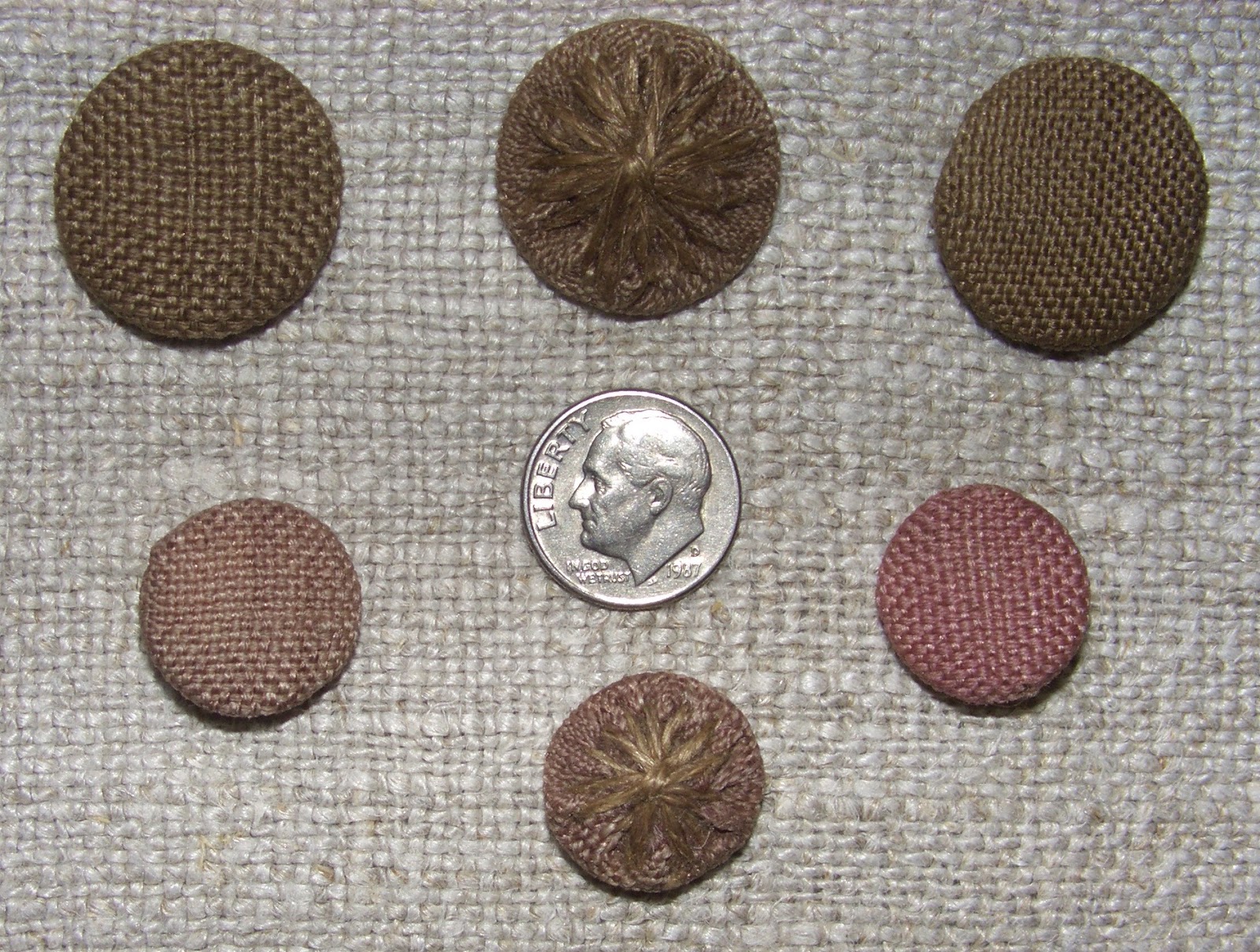
Cloth-covered buttons with dime for scale. The middle buttons in the top and bottom rows are flipped to show how the fabric is secured on the reverse around the wood cores.

I thought over these buttons. They were great examples of the sort used on men's and some women's clothing in the eighteenth and early nineteenth centuries. You can read a bit about the button "moulds" of forms here and see some in action on a pair of breeches here. I'll confess, I snuck away for a moment and cheated. I did an internet search using Nicole’s phone to make sure that there weren’t a dozen other such button sets floating around on eBay. There weren’t, luckily. So I had to buy them. After all, how often does a second chance like that come around? 

The challenge now was to figure out how much of the story was true. I had talked with the dealer, who told me that she bought them from another dealer who had bought a whole bag from descendants of the Toppan family of Hampton, New Hampshire. Of the two bags of buttons Christopher Toppan supposedly recovered, one had been water damaged but the other intact. And, so the story went, a bag of cloth-covered buttons from the wreck descended in the family right up until recently, when the dealer broke them up into little sets for resale. That, at least, explained how I had come across two different groups of buttons with the same unusual provenance and justified my skepticism about just how many sets there might be.

I initially despaired of finding much online about the shipwreck. There isn't as much digitized source material online for 1725 compared to, say, 1865, because newspapers and other printed material became more common over time.  Moreover, there were hundreds of shipwrecks on the coasts of early America, many of which received little or no printed attention. But when I focused on Christopher Toppan’s name and on Hampton, I got a few hits. Gradually, I started to piece together the story.

As it turns out, the wreck of interest happened not in 1725 but in 1764. That year, Captain Mallard had a string of bad luck. Based on New England newspaper accounts, he sailed from London on the St. George in May, but a few days out of port the ship sprung a leak and put into Portsmouth, England, for repairs. From here, things get hazy.

Early American newspapers often contained a lot of hearsay. They reprinted stories from other papers freely and relied on word-of-mouth to announce the arrival, departure, and sightings of ships. Some accounts said that Mallard had taken command of another ship, the Essex, or that the Essex, under a Captain Hugget, had taken on the St. George's cargo, or that the St. George had later put into Lisbon for more repairs, or that the Essex had arrived in New England, or that the St. George had delivered various parcels to Boston in late November. A ship wrecked near Hampton, New Hampshire, on November 30, but accounts disagreed about whether it was the Essex or the St. George. Here, for instance, is The Boston Evening-Post's version of the events:


My conclusion, after reading the conflicting reports, is that there were in fact two mast ships in the area in the early winter of 1764, the Essex and the St. George. Mast ships carried the straightest, tallest trees back to England to be used for (what else?) masts on British naval vessels, but they also transported other cargo and passengers. In this case, they demonstrate why historians need to use multiple sources in their research. Most of the newspaper accounts I located referred to the wrecked ship as the Essex. But documents digitized by the Lane Memorial Library in Hampton, New Hampshire, including both primary and secondary works, referred to the ship as the St. George. Most importantly, newspaper stories published after the wreck, once things had settled down, all referred to it as the St. George. Just like today, first reports were unreliable and media more distant from the event were more prone to inaccuracies. Among snippets about Indian missionary work and public punishments, The New Hampshire Gazette and Historical Chronicle offered the most succinct and accurate account of the wreck, on December 7, 1764:


What's so important about the actual name of the ship to the story of my buttons? Isn't it enough to know they're from a shipwreck? Initially, I thought that's all I'd get. And if I hadn't checked some other sources and instead concluded the wreck was that of the Essex, I might not have uncovered a more interesting story. When I started looking into Christopher Toppan, however, I was able to make the connection with the 1764 wreck of the St. George, mentioned by Hampton writers including Peter Evans Randall and James W. Tucker.

Christopher Toppan, ca. 1790s, from here.

Intriguingly, it seemed that, along with another prominent Hampton resident, Jonathan Moulton, Christopher Toppan was invested with responsibility for the wreck by the New Hampshire Court of Vice-Admiralty. The two men then purchased salvage rights, much to the consternation of locals who wanted to claim the flotsam for themselves. Writing in 1888, Lucy Ellen Dow described the “wrath of the people” which followed Moulton and Toppan’s purchase and which initiated a riot “of so serious a nature as to necessitate the calling out of the militia.”

I was a bit skeptical about the riot part. Sometimes, local amateur historians rely on folklore, which is notoriously difficult to prove or disprove with historical documents. Low and behold, however, the primary source behind Lucy Dow’s description can be found in her father Joseph Dow’s History of Hampton. The St. George’s cargo, fittings, and even the hull (although this last was aground in the surf) were auctioned on December 27, 1764. A month later, New Hampshire Royal Governor Benning Wentworth did indeed call out a small number of the militia to assist the local sheriff. His letter is worth quoting at length:

“Some ill disposed persons having purloined sundry goods from the Lading of a ship lately stranded on Hampton Beach in this Province while the ship & cargo was under the direction of & in the custody of the admiralty court; & warrants being issued for the apprehending sundry persons supposed to be guilty of the said Breach of the Law, who being apprehended for the same & in custody of the officer [High Sheriff], when as is further suggested, the prisoners were by a number of evil-minded persons in a violent, riotous & tumultuous manner & being disguised, did assault the officer & him beat, wound & evilly entreat & did release the sd prisoners & let them go at large whereby they made their escape & that since the above sd action (which was on the 28th day of this inst) a great number of the inhabitants of the sd town of Hampton have in a riotous, roysterous & tumultuous manner assembled, & being armed with clubs & staves, have menaced & threatened the officer & bid defiance to all lawful authority, & tho his Majesty's Proclamation agreeably to the law of the Province has been read to them, they still repeat their unlawful assembly to the great Terror of his majesty's good subjects...”

So, it seems, the St. George’s cargo was valuable enough, and its dispersal controversial enough, that it did in fact spur something like a riot in Hampton in the early days of 1765, only a few short months before Bostonians and other colonists took to the streets to protest the Stamp Act.

More recently, a few other probable relics of the St. George have surfaced. In 1962, two young divers raised a cannon, mill stones, and other artifacts from the purported wreck site, and in 1992 another diver found an old anchor believed to be from the ship. To the best of my knowledge, no archaeological work or extended research has been conducted on the wreck site or the St. George's history.

Skip Hird and David Conrad with the possible St. George cannon, 1962. From here.


The possible St. George anchor, early 1990s. From here.

So, are my buttons in fact a relic of the St. George? According to their provenance, they descended in the Toppan family, and Christopher Toppan could certainly have saved them from the wreck’s cargo. The buttons are definitely original and date to the eighteenth or early nineteenth century. The variety of their sizes and colors, their unused condition, and the fact that there are other groups of comparable buttons out there from the family’s original group all suggest that these were buttons meant to be sold. If they were on the St. George, they were part of a merchant's shipment. They were not simply, for example, saved by the Toppan family from a worn-out garment for reuse and later attached to the wreck story. 

I still have some lingering doubts about the buttons' connection to the St. George. They are covered in coarse linens, and it seems unlikely that such buttons would be imported and sold when they were so easy to make. Why would a tailor or seamstress have bought a button when it was so easy to make one in minutes using fabric that matched or coordinated with a garment (like on this coat)? Moreover, of all the things Christopher Toppan and his descendants could have saved and remembered, why a bunch of cheap buttons? 

I’ll probably never know the answers to these questions. But for now, I’m still a believer. I like the story and, anyway, the evidence is inconclusive for either side of the argument. I like thinking that these little buttons are part of a bigger story. And I like that they found me.

Sunday, July 17, 2011

"Estate Sale": Newport

Two days ago, as I was driving to my temporary digs after work, a prominently posted white sign with black lettering caught my eye.

ESTATE SALE! Antiques! Military! Tomorrow!


Oh, my.

My mouth watering, I did a drive-by after dinner so I would be familiar with the neighborhood the following morning. The house looked a little shabby. White shingles, covered in green moss (not of the decorative variety). But I decided it was worth the short drive. You never know what you may find, and I was hoping for a good deal after coming home from Brimfield nearly empty-handed.

The sale was scheduled to open at 7:30AM. I debated whether I should stand around at 5AM, but I decided to take my chances since I needed to get enough sleep. And so, instead of reading the news yesterday morning before working, I hopped into my still dew-covered car and headed back to the estate sale house.

As I pulled up to the block I had visited the previous night, I spied two women putting an old-looking folding stool into their trunk, which angered me since it was prior to the time the sale was to open. As I approached the house, I was somewhat confused. No line, no numbers, and the house was opened before the advertised sale time. Where was the organized chaos to which I was accustomed in northern Delaware and southeastern Pennsylvania? There are ground rules for such sales, but apparently no one in Newport adheres to them. Don't get me wrong, I hate standing in line for hours, but at least it gives me a chance to size-up the competition. I like to identify the real pickers ahead of time so I can scuttle in front of them.

Undeterred, I walked up the driveway. The front door and the garage were wide open. A grumbly woman emerged.

"Is this the location of the estate sale," I asked cheerily.

"Yeah...if you can call it that," she responded. "It's mostly junk."

Perfect, I thought.

Sure enough, the treasures were few and far between. The clientele appeared to be comprised mostly of middle class Newporters, and no one looked too crazed. As I creeped into the house, I walked past a chair busting at the seat, some veteran's WWII (?) gear and memorabilia, and a lot of glass whatnots from the twentieth century. Along a wall in the living room, a long table displayed most of the small goods. I spied two framed tintypes immediately. (I wrote about tintypes before. See this post and this post.) I picked up one full plate (about 6.5" by 8.5") tintype portrait of a man:


and was pleased to see what may be the original photographer's mark on the back. I do not have access to my usual library this summer, but a friend suggested that this gentleman's costume suggests that the photo dates to the 1850s or 1860s. I could not find too much information online about the photographer, but one web site noted that extant photographic images by the firm date from the 1870s-1880s. Of course, I cannot be sure that the Prior brothers produced this image just because their mark is on the back of the frame. Perhaps Tyler will take this apart later to see if he can find additional clues as to its origins.

I put it down, and picked-up an older woman nearby:

She came in a frame similar to that of the man, but the glass is broken. Because of that, I removed the full plate tintype and photographed it outside the frame. Her costume suggests that tintype may date to the 1860s. Is she wearing a wig?

As I examined the older woman, a fellow picker grabbed the man. I panicked, realizing that I should not have put him down (first rule of picking: never put anything down until you are certain you will not buy it!). For a few seconds, I cursed myself as she considered the find. Finally, she set the man back down on the table. I swiftly snagged him and cradled him--dirt, mold, and all--in my arms.

Unlike sales I have attended back home, nothing was priced (except a few Hummels--I suppose they have a price guide in their library).

"Can you tell me how much you would like for these please?" I asked the thin and pleasant woman who seemed to be running the sale with her husband and her teenage son.

I figured they couldn't be asking more than $20/each and was pleasantly surprised to learn that they were only $10/each.

"Great!" I said. I asked her to set them aside for me as I looked around once more.

Since the tintypes were a mere $20 investment, I decided to scoop-up a fading stereo view ($1) as well.


The underside reads "A.J. Davis/Slaughter House." It also bears the stamp "ALDEN PHOTO CO./503 WASHINGTON ST/BOSTON." Some information floating around the internet indicates that the Alden Photo Co. was in operation in the 1870s and 1880s.

At these prices, there was no reason to be too particular.

After the tag sale manager removed the spider nest from one of the frames, I paid and escaped with my treasures, pleased that, if anything, I got a deal.

Sunday, February 20, 2011

Material Culture Minute: The Best Things in Life are (Almost) Free

A few weeks ago, just before the spring semester began, Tyler and I ventured to the Paper Americana Show in Elkton, Maryland. Paper and ephemera shows attract an interesting group of people. Paper and ephemera collectors are definitely different from collectors who gravitate toward furniture, ceramics, etc. Many ephemera booths categorize their stock into themes. For instance, someone who specializes in trade cards and trade catalogues often creates categories such as "food and drink;" "health and medicine;" "animals"; "sports"; specific states such as "Delaware"; "foreign," etc. Why? Because paper and ephemera collectors tend to collect items that fall into only a handful of themes. I didn't quite get this until after I attended a few of these shows and found myself looking through only a handful of themes (health and medicine, needlework, etc.). This makes sense, as paper and ephemera shows feature way more stock than a regular antiques show does. You couldn't go through it all if you wanted to. The problem arises when you run into a collector interested in all things "Delaware" who takes over not only the "Delaware" box of postcards, menus, car dealership advertisements, etc., but also a three feet perimeter around the Delaware box. That means that Connecticut and Florida collectors will have to wait for an untold number of minutes to see if they can find any treasures in their respective boxes. Not all paper and ephemera collectors are this territorial, but there are enough out there to make browsing difficult. Beware.

At any rate, Tyler and I didn't find anything extraordinary, but we picked up a few interesting photos and other pieces of ephemera for a few dollars here and a few dollars there.

For example, here is a great late nineteenth-century tintype featuring some ladies wearing identical plaid or checked skirts.


And here, we have a snapshot of a woman in a well-stocked general store.


And who can't resist shoes? Below is a 1866 receipt for a pair of shoes. The cordwainer in question worked in his trade through the nineteenth century in Wrightsville, Pennsylvania, in York County, and he also served in the Civil War.


Here, we have a late nineteenth-century trade catalogue for paper collars. Tyler and I were hoping that the brand name was the same as the one of the paper collar box I purchased in Michigan in January, but, alas, we misremembered the name. Either way, the catalogue can be used in conversation with the contemporaneous box.


And finally, I got all this at a steep discount. About a week ago, I found an envelope in my mailbox from the Singerley Fire Company in Elkton, MD. I immediately thought of the paper show and the door prize drawing I entered, but I also wondered if I was being tapped to donate to a firehouse 20 miles away.

Sure enough, the envelop contained a lovely note congratulating me on winning ($25, which covered about 80% of the total cost of my purchases) and letting me know that they hoped that I had had a lovely time!

Thursday, December 2, 2010

A "Young Collector's" December Outing

The end of my first semester studying for a Ph.D. has been rather busy, and I have also been fighting a fever. However, my boyfriend, his classmate, and I battled crying babies and pushy old ladies (and men--I was scolded for looking through a pile of books a man set on the floor because they were too heavy to carry...boo hoo!) at local tag sale this morning. 

Twenty dollars later...(some highlights):


Yeah, that's Printed Textiles by Montgomery for just $4  (he found it, actually, and, although he picked it up for me, I insisted that he hand it over immediately).  It's in very good condition.  There is a small tear on the dust jacket at the top of the spine, and there is some mold on the edge.  Otherwise, this is is great condition.  I am glad I resisted dropping $150+ for it the few times I have seen it around in book stores.


Well, I have always had a weakness for stationary.  This is a stack of paper labeled for the Alpine Hotel in Philadelphia, made in the 1910s.

 
I don't know much about eastern textiles.  This is stamped "made in Iran/8 x 8" on the back.  I think it's a printed cotton. 


Ok, I almost didn't take this home with me.  I prefer to purchase things that I can display.  This will probably stay in my closet until I buy a box for it.  At any rate, I love the color and the style, and the face and lining fabrics felt old based on my run-ins with old tetxiles when I catalogued furnishing fabrics.  I think the style is 1820s, but I need to do more close looking to determine how old it really is.  It may be a later nineteenth-century costume made in an early nineteenth-century style.

All in all, a good morning.  I need to do more research on the Iranian textile, the dress, and the Alpine Hotel, so stay tuned.

In the mean time, I came across a column and blog that you might find interesting.  Hollie and Andrew maintain The Young Antique Collectors blog, and they also write a column for the Maine Antiques Digest called "The Young Collector."

Their most recent column, "The Last of the Young Collectors?", raises some interesting and troubling questions about the future of collecting among younger generations.  I think that museums, historic preservation institutions, etc., should try to reach out more to their younger visitors and patrons, even if this does not translate into donations.  Individuals in the trade, students, museum staff, as well as those in academia all rely on continued interest in material culture among the public, and few in the field seem to be going outside their comfort zones to generate new interest.  Encourage the public to start collecting young and to start with the easy targets (tag sales, yard sales, estate sales, etc.)! 

If you, dear reader, are a young skeptic, get thee to an estate or tag sale and buy yourself a book shelf or dining table that is not made of particle board, and find something colorful to hang on your wall.  Trust me, standing in line on a crisp December morning for fifteen minutes is worth the years of pleasure and use you will get our of your bookshelf and framed print.  You may even learn something from your objects.