By guest blogger,
Tyler Putman:
When Nicole and I go antiquing, we search for cool old stuff, but, sometimes, objects find us. Regular readers of my (Tyler's)
blog might have
gathered that I’m particularly interested in, among many other things,
historical clothing and buttons. There's something fascinating about these little artifacts and all the things they can tell us about clothing and the people who wore it. Years ago, at the Mansfield, Ohio, Civil War Collectors
show, I came upon a small case of eighteenth-century cloth-covered buttons for sale.
They had been found, so the attached note said, washed up on a beach in New
England after a shipwreck. The price was a little high for me, though, and by
the time I made up my mind to go back for them later in the day, some other
savvy collector had snapped them up. And so I wrote them off, adding them to
the “should have bought that” list that I suspect every collector secretly
maintains.
Then, a couple months
ago, at an antique show Nicole and I visit annually at the
Singerly Fire Hall
in Elkton, Maryland, I happened upon another small case of buttons with an
eerily familiar provenance:
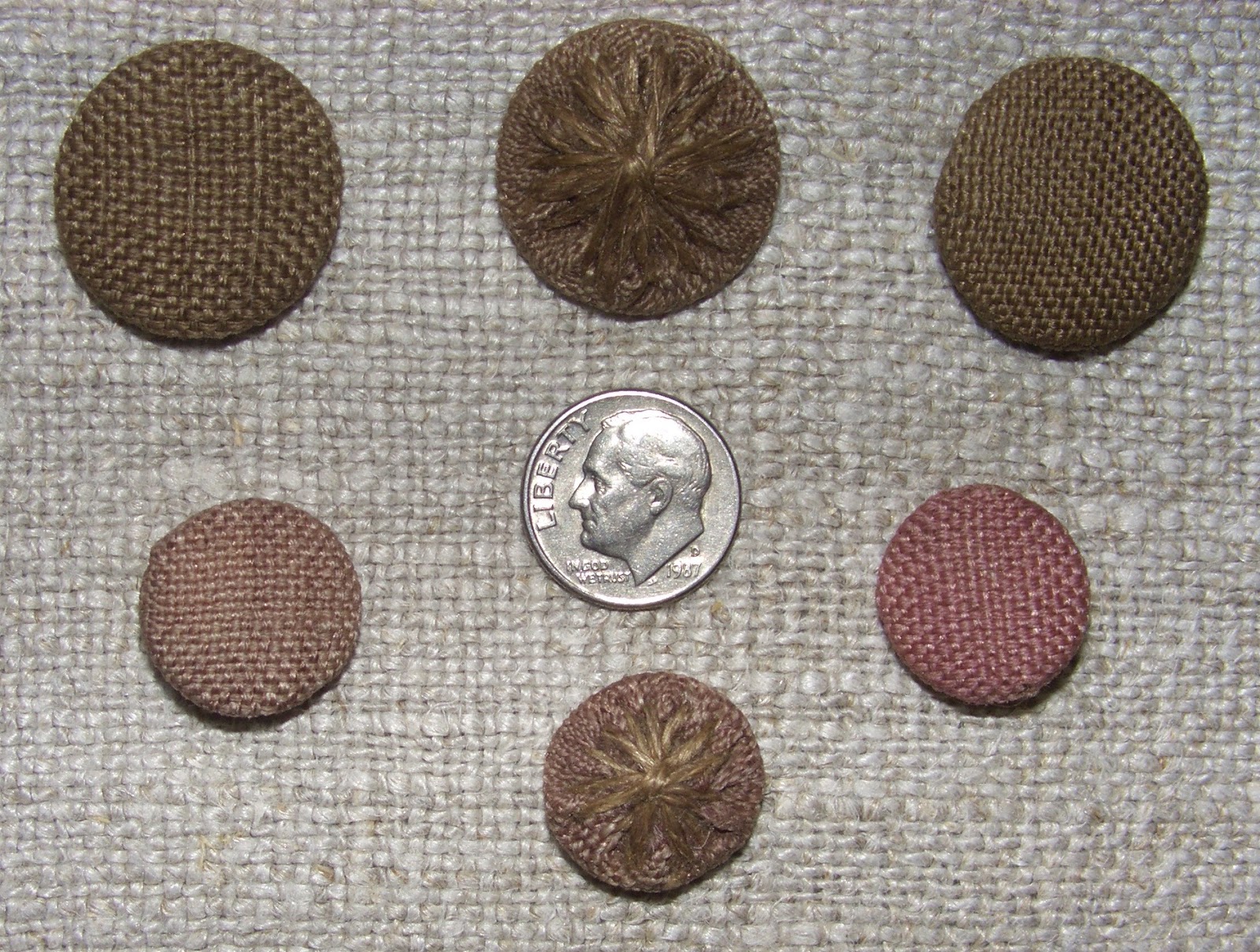
Cloth-covered buttons with dime for scale. The middle buttons in the top and bottom rows are flipped to show how the fabric is secured on the reverse around the wood cores.
I thought over these
buttons. They were great examples of the sort used on men's and some women's clothing in the eighteenth and early nineteenth centuries. You can read a bit about the button "moulds" of forms
here and see some in action on a pair of breeches
here. I'll confess, I snuck away for a moment and cheated. I did an internet search
using Nicole’s phone to make sure that there weren’t a dozen other such button
sets floating around on eBay. There weren’t, luckily. So I had to buy them.
After all, how often does a second chance like that come around?
The challenge now was
to figure out how much of the story was true. I had talked with the dealer, who
told me that she bought them from another dealer who had bought a whole bag
from descendants of the Toppan family of Hampton, New Hampshire. Of the two bags of buttons Christopher
Toppan supposedly recovered, one had been water damaged but the other intact. And, so the
story went, a bag of cloth-covered buttons from the wreck descended in the
family right up until recently, when the dealer broke them up into little sets
for resale. That, at least, explained how I had come across two different groups
of buttons with the same unusual provenance and justified my skepticism about
just how many sets there might be.
I initially despaired
of finding much onli
ne about the shipwreck. There isn't as much digitized source material online for 1725 compared to, say, 1865, because newspapers and other printed material became more common over time. Moreover, there were hundreds of shipwrecks on the coasts
of early America, many of which received little or no printed attention. But when I focused on Christopher Toppan’s name and on
Hampton, I got a few hits. Gradually, I started to piece together the story.
As
it turns out, the wreck of interest happened not in 1725 but in 1764. That year, Captain Mallard had a string of bad luck. Based on New England newspaper accounts, he sailed from London on the St. George in May, but a few days out of port the ship sprung a leak and put into Portsmouth, England, for repairs. From here, things get hazy.
Early American newspapers often contained a lot of hearsay. They reprinted stories from other papers freely and relied on word-of-mouth to announce the arrival, departure, and sightings of ships. Some accounts said that Mallard had taken command of another ship, the
Essex, or that the Essex, under a Captain Hugget, had taken on the
St. George's cargo, or that the
St. George had later put into Lisbon for more repairs, or that the
Essex had arrived in New England, or that the
St. George had delivered various parcels to Boston in late November. A ship wrecked near Hampton, New Hampshire, on November 30, but accounts disagreed about whether it was the
Essex or the
St. George. Here, for instance, is
The Boston Evening-Post's version of the events:
My conclusion, after reading the conflicting reports, is that there were in fact two mast ships in the area in the early winter of 1764, the
Essex and the
St. George. Mast ships carried the straightest, tallest trees back to England
to be used for (what else?) masts on British naval vessels, but they also
transported other cargo and passengers. In this case, they demonstrate why historians need to use multiple sources in their research. Most of the newspaper accounts I located referred to the wrecked ship as the
Essex. But documents digitized by the
Lane Memorial Library in Hampton, New Hampshire, including both primary and secondary works, referred to the ship as the
St. George. Most importantly, newspaper stories
published after the wreck, once things had settled down, all referred to it as the
St. George. Just like today, first reports were unreliable and media more distant from the event were more prone to inaccuracies. Among snippets about Indian missionary work and public punishments,
The New Hampshire Gazette and Historical
Chronicle offered the most succinct and accurate account of the wreck, on December 7, 1764:
What's so important about the actual name of the ship to the story of my buttons? Isn't it enough to know they're from a shipwreck? Initially, I thought that's all I'd get. And if I hadn't checked some other sources and instead concluded the wreck was that of the
Essex, I might not have uncovered a more interesting story. When I started looking into
Christopher Toppan, however, I was able to make the connection with the 1764 wreck of the
St. George, mentioned by Hampton writers including
Peter Evans Randall and
James W. Tucker.
Christopher Toppan, ca. 1790s, from here.
Intriguingly, it seemed that, along with another prominent Hampton resident,
Jonathan Moulton, Christopher Toppan was invested with responsibility for the wreck
by the New Hampshire Court of Vice-Admiralty. The two men then purchased
salvage rights, much to the consternation of locals who wanted to claim the
flotsam for themselves. Writing in 1888,
Lucy Ellen Dow described the “wrath of
the people” which followed Moulton and Toppan’s purchase and which initiated a
riot “of so serious a nature as to necessitate the calling out of the militia.”
I was a bit skept
ical
about the riot part. Sometimes, local amateur historians rely on folklore, which is notoriously difficult to prove or disprove with historical documents. Low and behold,
however, the primary source behind Lucy Dow’s description can be found in her
father Joseph Dow’s History of Hampton.
The St. George’s cargo, fittings, and
even the hull (although this last was aground in the surf) were auctioned on
December 27, 1764. A month later, New Hampshire Royal Governor Benning
Wentworth did indeed call out a small number of the militia to assist the local
sheriff. His letter is worth quoting at length:
“Some ill
disposed persons having purloined sundry goods from the Lading of a ship lately
stranded on Hampton Beach in this Province while the ship & cargo was under
the direction of & in the custody of the admiralty court; & warrants
being issued for the apprehending sundry persons supposed to be guilty of the
said Breach of the Law, who being apprehended for the same & in custody of
the officer [High Sheriff], when as is further suggested, the prisoners were by
a number of evil-minded persons in a violent, riotous & tumultuous manner
& being disguised, did assault the officer & him beat, wound &
evilly entreat & did release the sd prisoners & let them go at large
whereby they made their escape & that since the above sd action
(which was on the 28th day of this inst) a great number of the
inhabitants of the sd town of Hampton have in a riotous, roysterous &
tumultuous manner assembled, & being armed with clubs & staves, have
menaced & threatened the officer & bid defiance to all lawful
authority, & tho his Majesty's Proclamation agreeably to the law of the
Province has been read to them, they still repeat their unlawful assembly to
the great Terror of his majesty's good subjects...”
So, it
seems, the St. George’s cargo was
valuable enough, and its dispersal controversial enough, that it did in fact
spur something like a riot in Hampton in the early days of 1765, only a few
short months before Bostonians and other colonists took to the streets to
protest the Stamp Act.
More
recently, a few other probable relics of the St. George have surfaced. In 1962, two young divers raised a cannon,
mill stones, and other artifacts from the purported wreck site, and in 1992 another diver found an old anchor believed to be from the ship. To the best of my knowledge, no archaeological work or extended research has been conducted on the wreck site or the St. George's history.
Skip Hird and David Conrad with the possible St. George cannon, 1962. From here.
The possible St. George anchor, early 1990s. From here.
So, are my
buttons in fact a relic of the St. George?
According to their provenance, they descended in the Toppan family, and
Christopher Toppan could certainly have saved them from the wreck’s cargo. The
buttons are definitely original and date to the eighteenth or early nineteenth century. The variety of their sizes and colors, their unused condition, and the
fact that there are other groups of comparable buttons out there from the
family’s original group all suggest that these were buttons meant to be sold. If they were on the St. George, they were part of a merchant's shipment. They were not simply, for example, saved by the Toppan family from a worn-out garment for reuse and later attached to the wreck story.
I still have some lingering doubts about the buttons' connection to the St. George. They are
covered in coarse linens, and it seems unlikely that such buttons would be
imported and sold when they were so easy to make. Why would a tailor or seamstress have bought a button when it was so easy to make one in minutes using fabric that matched or coordinated with a garment (like on this coat)? Moreover, of all the things Christopher Toppan and his descendants
could have saved and remembered, why a bunch of cheap buttons?
I’ll
probably never know the answers to these questions. But for now, I’m still a believer.
I like the story and, anyway, the evidence is inconclusive for either side of
the argument. I like thinking that these little buttons are part of a bigger
story. And I like that they found me.