Showing posts with label books. Show all posts

Sunday, January 22, 2012

On Moving with Antiques and Books…and Combining Two Collections

 As a friend dragged one of Tyler’s books from the moving truck, she concluded that the “War” label on the top indicated that the box contained cannon balls rather than books.

Why the confusion? 

Tyler took the “Tetris” approach to packing his boxes, whereas I packed boxes I could physically haul myself.  If you're moving with books like we did the other week, we recommend that you do not over-stuff boxes of books. My boxes were bearable to lug from one town to the next; Tyler’s were not. 

Moving the books was difficult, but parting with those that simply did not fit into our new space was an emotional battle that played out over a fortnight.   Overall, our libraries complement each other’s well.   I was short on books about metals, warfare, and ceramics, and Tyler was short on books about textiles (especially needlework), religion in America, and history of the book and print culture.  All told, we estimated that we brought over 2,000 books into our new home.  We do not have room for 2,000 books.  So after we identified the books we couldn’t live without and placed them on book shelves, we pruned the collection and separated the rejects into books to sell/donate to Goodwill (Bands and Drummerboys of the Civil War and a Catholic Bible) and books to offer to friends (duplicate copies of Montgomery’s Textiles in America and Blassingame’s The Slave Community).   There were some cases where we had to keep two copies of a single book.  For example, I own an autographed copy of Styles’ Dress of the People, and Tyler owns a copy I gave him and inscribed.     
In the case of Demos’ classic A Little Commonwealth, we owned two revised paperback editions and one original hardback first edition.  We couldn’t discard the original, and I insisted on keeping the copy with the revised introduction.
Don’t they look nice next to each other? 

And there were instances in which each of us defended keeping certain tomes most reasonable people would have discarded.  I decided that we needed both the first and second editions of Krill and Eversmann’s Early American Decorative Arts (foundational references for material culture! One of the first books about decorative arts I ever bought! Beautiful cover on the first edition! I’m cited in the updated edition!), and Tyler insisted on keeping his beloved Biesty’s Cross-Sections: Man-Of-War (an illustrated children’s book he dubbed an “equally valuable reference” in comparison to Early American Decorative Arts).1  

But we don’t just have books.  We also have [an]‘tiques.

Pack your stuff as professionally as you can afford.  As long as you’re not moving too far and you’ll be unpacking right away, there is no shame in using cardboard boxes (which really aren’t “conservation safe”), bubble wrap, and packing paper to swaddle your gout pots, case photographs, export china, and red mid- (20th-) century lamps.   If you run out of packing supplies at the last minute, Tyler suggests using Nicole’s (clean) bath towels to fill in the nooks and crannies.

You’ll be able to stuff a lot of things into cardboard boxes or, in our case, our “empty space” (chests, trunks, and the like), but some stuff will need to be carefully transported and carried with minimal packaging materials  by hand (unless you have a more robust moving budget than we did!).   This means that your friends might be parading some unusual things out of your truck, into your home, and up your stairs.  Thus, you need to be prepared to defend your antiques collection to the friends who help you move.   You might think an early nineteenth-century mousetrap or a cobbler’s bench are cool, but you will likely need to take a moment to explain why they’re so cool to your friends (you think old mousetraps are sculptural in the case of the former and you appreciate crafts of all kinds in the case of the latter).2 

On the bright side, having a lot of books means that you have some bonus display space on top of bookshelves for your antiques.

But when you need to downsize to accommodate your alarm clock and printer, you need to know the best way to part with some things.  How many mid-nineteenth-century glass alcohol bottles does one really need?
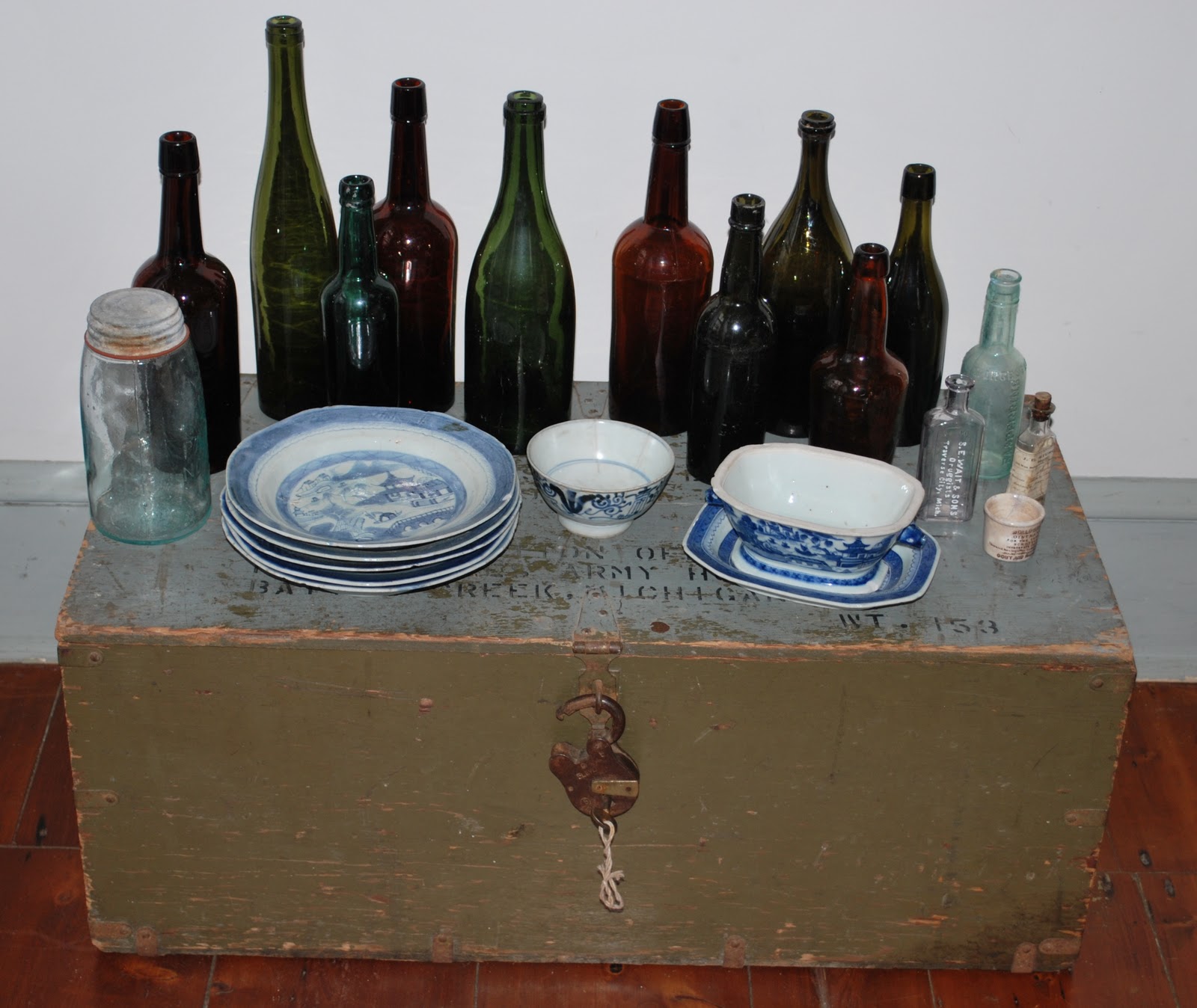
Probably not the eleven Tyler owns. 

But if you need to downsize, find your local flea market and set up a stall some Sunday, or take to eBay.  You’ll generate some extra cash, and you won’t be tripping over grenade boxes or farming implements.  Sometimes it takes moving all the cannon balls into your new place before you can figure out which ones should stay and which ones need to go.

Notes

1. The final tally:  1,172.

2. Tyler took his cobbler’s bench to Goodwill; it’s a mid-century reproduction, and he (surprise) never uses it.

Further Reading

For a recent opinion piece on why and how historians and other humanists continue to cultivate personal libraries in the days of digitization, see William Pannapacker, “We’re Still in Love With Books,” The Chronicle of Higher Education, December 4, 2011.

Thursday, July 28, 2011

Reading Bill Bryson’s At Home: Chapters 12 and 13: The Garden and The Plum Room

Tyler

In these two chapters, Bryson takes us on a tour of the grounds and exteriors of our Western homes. We tramp around cemeteries and topiary gardens. Bryson’s own “Plum Room,” so named for its wall color, serves to introduce us to famous architects and bibliophiles. Bryson’s notes on Thomas Jefferson, perhaps America’s most notable sometime architect and lifetime book hound, got me thinking about my own fascination with books. Despite numerous moves across several states, I have still held onto a staggering amount of books (although luckily for now fewer than Jefferson’s own 10,000+). My own interests are not quite as eclectic as Jefferson’s, but I do find reasons to keep volumes on subjects as diverse as household insects, polar exploration, and early American furniture. Many of these sub-collections are products of my various jobs and degrees, like the several dozen archaeology books I usually sequester on some lone shelf. And against my better judgment, I still find books almost everywhere I go. I religiously stop at used bookstores and rarely leave empty-handed. For me, these little adventures are where I encounter fascinating treasures I’ve never heard of, even in genres in which I’ve delved for years. I also like to think that in an age of internet bookstores and internet media, I’m helping to support an institution—the brick-and-mortar bookstore—that represents a connection to the first citizens of our nation.

Perhaps in a decade or two there will be no more books rolling off the presses as we move into a world of e-readers. But for me, there is nothing like reaching up to my shelf and finding the reference I’m looking for, nothing like feeling the comfortable weight of a book in my lap, nothing like knowing that in each of these volumes is a wealth of human learning, creation, and art. So that’s why, wherever I end up, I’ll have my own Plum Room, filled with these textual treasures. I like to think that Jefferson would be proud.

Nicole

In January of 2008, I took a two-week field trip to London and Bath while I was pursuing my M.A. We visited many museums and other sites of cultural significance including Beckford's Tower in Bath (Bryson mentions Beckford and his eccentricities on several occasions throughout the book). According to Bath Preservation Trust, Beckford intended for the tower to serve as a "study retreat" and as a place for Beckford to store and display his "art and rare books" collections (swell idea, Beckford!). The Tower turned out to be fascinating, but upon our arrival, I could barely get past the graveyard situated next to the tower.

Our gracious and informative host had begun her tour at the Tower, but I was mesmerized by the Lansdown Cemetery next door.

As I snapped several photos, one of my professors called me back to the group. The cemetery remains among my favorite sites visited (however fleetingly) during those two weeks. But I never stopped to think about why.

For one, as Bryson suggests, sites for buying the dead--whether they are seventeenth- or eighteenth-century public burying grounds or private church yards or nineteenth-century park-like or landscaped cemeteries---are attractive places. In his chapter on the garden, Bryson links the nineteenth-century garden-type cemetery movement to domestic gardening and a growing interest in designing healthy outdoor recreational spaces (270-272). These ruminations brought to mind my current research on a gravestone in one of Newport, Rhode Island’s, cemeteries.

A gravestone?

Until this summer, I admit that I never thought that I would study cemeteries or grave markers. I live across from a cemetery in a sleepy town in Delaware, but until now, it was just atmosphere. I had unfairly associated others’ grave marker enthusiasm with antiquarian interests gone awry. A cemetery is a cemetery is a cemetery, I thought...until you start to look more closely at the grave marker materials, shapes, designs, and the cemetery configurations.

And the people.

In many cases, learning about the people underneath the stones would be nearly impossible if the stones did not survive. In some cases, cemeteries make private life painfully public.

The most striking aspect of cemeteries is that, since many are open to the public, they serve as unique opportunities for anyone to study material culture up close and personal. No white gloves or stanchions here. Cemeteries allow interpreters of material culture to bring the public into the field (literally) to think about a range of historical themes such as everyday life and family relations, race, social status, the craft of stone-cutting and carving, commemoration practices, and how all these things change over time and are different across a single town or between two countries. Cemeteries long abandoned or minimally cared-for also present individuals and groups with opportunities to engage in preventative conservation. In short, cemeteries are ideal object study laboratories, and they can be found just about everywhere.

I did not have a chance to walk around Lansdown Cemetery that day in January. But when I return, I will do more than gape at its eerie beauty. Instead, I will think more critically about what I can learn about the past from being up close and personal among the grave markers and the people for whom they were erected.