Showing posts with label Berlin work. Show all posts

Sunday, April 27, 2014

Stocking Up

It's a real pleasure to receive an invitation to lecture on my M.A. thesis topic--Berlin work--five years after I finished that degree and three years after publishing an article based on that research. I must admit that I had that Spring 2015 lecture in mind upon purchasing Elizabeth Gotvals's 1847 sampler at my favorite antique shop near in Pennsylvania last weekend.


Wow, an identified and dated piece of Berlin work, made when Americans had only begun to embrace the needlework made using soft woolen threads and patterns printed in women's magazines and sold by the piece in fancy shops. I'm not sure if the backing is lignin-free and acid-free, so I'll probably carefully switch it out with something I can confirm is inert and therefore less likely to speed the sampler's inevitable deterioration. That said, it's in pretty good condition. I am simply thrilled to add this to my collection. But, frankly, it's always a good day when I have an opportunity to stock up on Berlin work specimens I can trot out for my lecture audiences (not to mention my students). Nothing beats learning from the objects themselves.

So what do we have here?

Elizabeth's work includes a traditional "sampler" design at the top featuring the alphabet and numerals in silk on plain-woven cotton canvas. The bottom portion features Berlin work designs (mostly floral) in wool. As I have explained before, needlework collectors tend to shy away from this stuff for a few reasons. Many people think it's 1) unoriginal and 2) gaudy. The wool's colors are too bright and therefore tasteless, some think. Critics also believe that the Berlin needlework designs, wrought using widely disseminated patterns as guides, embodies a lack or imagination on the part of the needleworkers.


I'll leave it up to you do decide for yourself how you feel about it.

In the mean time, I'll keep collecting it and lecturing about it.

Further Reading

For more about Berlin Work, see my article in Winterthur Portfolio: "'The Blood of Murdered Time': Ann Warder's Berlin Wool Work 1840-1865," Winterthur Portfolio 45, 4 (Winter 2011): 321-352.

I have also written about Berlin work on this blog before. Check out this post, "Berlin work: craft, kitsch, and fashion."

Berlin Work in Museums

In my region, some of my favorite Berlin work can be found at the Winterthur Museum and the Schwenkfelder Library and Heritage Center.

Friday, March 7, 2014

Stuck Between a Decoy and some Berlin Work

Norman Rockwell's Good Friends (1925) & #UDFlat_SPencer
I was practically born in a flea market. Thus it should come as no surprise that I could spend the rest of my life wandering the aisles of antique malls. So when Tyler and I visited the Brandywine Conservancy and Museum of Art (formerly the Brandywine River Museum) last Saturday to catch some Norman Rockwells in the flesh (at left), it was a forgone conclusion that we'd visit a favorite antique co-op just up the road.


What did we find? 


About five minutes into the visit, I spotted some ice fishing decoys similar to these beauties at the American Folk Art Museum. On one, priced at $85, the fins had been made using recycled news- or magazine-print. How charming, I thought. It reminded me of the make-do spirit embodied in many of the artifacts at the Upper Bay Museum in North East, Maryland.

Horace Graham's (active 1955-1978) auto-sander made with a washing machine motor
at the Upper Bay Museum
Since I had recently completed eight blissful days of work there documenting, deinstalling, inventorying, cataloguing, cleaning, and reinstalling a period room Decoy Shop (you can read more about that here - it was part of the University of Delaware Museum Studies/Sustaining Places museum inventory SWAT program), my duck decoy and hunting and fishing tool radar remains finely tuned into that stuff.


Tempting!


But a mere five minutes later, I spotted a large framed piece of Berlin work (a type of wool on cotton canvas pictorial fancy needlework popular in the mid nineteenth century) in the next room and made a beeline for it. At right, check out an example of Berlin work, which, as it turns out, I acquired from the same antique mall about a year ago. Tyler helped me get the prospective purchase off the wall but not without knocking down its hook in the process. An eagle-eyed co-op worker happened to be walking by. We apologized, and she told us not to worry about the casualty. But then proceeded to stand next to me pretending to be reading some paperwork while I examined the piece. 

Like the one I bought a year ago, the prospective acquisition had provenance, and the price was right. (I have found that the pictorials, often featuring a scene and perhaps a name, call for less than do the sampler-style Berlin work, often featuring images as well as names, dates, and perhaps letters or numbers.) It had a lot going for it. But I am trying to save some pennies for a variety of things ranging from groceries to a 2015 tour of Waterloo and its environs. 

So after carefully setting the needlework against a wall, we did a loop of the rest of the co-op. I saw a few more decoys--once you work with something, you see it everywhere--but none that I found to be particularly beguiling. In my travels, I've seen duck decoys range in price from under $100 to several hundred dollars. If you follow that market at all, you know they can fetch tens of thousands. Once a utilitarian, everyday item used not alone but in groups of tens or perhaps a hundred, after the decline of market duck hunting in the early twentieth century and then the transition to plastic decoys in the mid-century, duck decoys skyrocketed in "folk art" and monetary value. And so with the death of the wooden decoy came the renaissance of decoy-carving and the start of the collecting fever.

Thus far, I have kept the miasma at bay. 

As predicted (and widely feared) it snowed Monday, March 3.
Not so for Berlin work, a subject near and dear to my nerdy little material culture heart. As we circled back to the Berlin work, we overheard a conversation between a co-op worker and a customer who had asked if the dealer could "do any better" on a metal rack with hooks. The worker explained that the dealer would give a 20% discount if the prospective buyer would pay by cash or check. The worker offered to put the rack on 24-hour hold. The buyer liked that idea but said that that wouldn't guarantee that she would buy it. After all, she noted, there's a snow storm coming.

And once she buys the rack, she still needs some money left over to paint it. 

"You're going to paint it?," the worker asked.

"Yes," responded the buyer.

"Oh...dear," the worker exclaimed, unable to hide her dismay and disgust. 


Just as breathing down someone's neck while they take a look at a piece of needlework isn't the best way to sway an interested buyer, neither is chastising someone's plans to "deface" an anonymous piece of metal.

Coverlet, wool & cotton, America, 1825
Metropolitan Museum of Art, 10.125.410
(I'm all for preservation, but you have to pick your battles, folks. I plan to transform my Berlin work into several tote bags. [Not really]. You laugh, but an acquaintance recently called to my attention an 1970s/80s article in an American "primitives" magazine that profiled a woman who made historic coverlets [like the one at right] into culottes.)

With the 'tique desecration exchange humming in the background, I hemmed and hawed for a few more minutes over the Berlin work. With dreams of Waterloo dancing in my head, at last, I decided we should head to Whole Foods. There, we chattered about living in a world where we can buy (but did not) $6.99 jars of "organic," "undyed" maraschino cherries at a place that employs guys to stand behind a fish counter wearing overalls in an effort to create the illusion that the workers are fresh off the docks.

I wonder if they know what ice fishing decoys look like.

Want to Learn More?

There are some good web sites that address decoy collecting. Check out the Collectors Weekly site on "Vintage and Antique Duck Decoys." Their interview with a decoy collector is also informative; it mentions several antiquarian books that would be of interest if you want to learn more about identifying decoys if you're on the hunt.

In preparing for my work at the Upper Bay Museum, I found that C. John Sullivan's Waterfowling on the Chesapeake, 1819-1936 (2003) provides readers with the best historical context for duck decoy use. Those with a theoretical bent might enjoy Marjolein Efting Dijkstra's The Animal Substitute: An Ethnological Perspective on the Origin of Image-Making and Art (2010).

Finally, if you hunger for more information on Berlin work, check out my article "'The Blood of Murdered Time': Ann Warder's Berlin Wool Work, 1840-1865," in Winterthur Portfolio

Thursday, July 19, 2012

Fancy This

My mom, wearing one of her
mother's expertly sewn creations.
Running my pale blue satin fabric through the sewing machine in my junior high home economics class, growing increasingly exasperated through every jerk and jumble, I knew early on that I could not expect to score an "outstanding" on the gym bag project.  The champagne-colored silk cord I selected to coordinate with the blue satin body failed to distract from the cockeyed rectangle I stitched together over four miserable class periods.  My maternal grandmother, an accomplished seamstress who made many outfits for my mother and other family members (including a gold silk dress trimmed with off-white "lace" à la Martha Washington for yours truly one Easter), might have been appalled.

My paternal grandfather, who stitched canvas boating accessories while working as a longshoreman, might have been equally dismayed.  This gym bag was, after all, a rectangle.  Yet my mom, who did not develop an affinity for sewing, financed the purchase of my unconventional gym bag materials and patted me on the back for a job well attempted.  Like me, she wasn't much of a sewer and probably sympathized with my frustration (but she has told me that she made a few pieces of clothing and some curtains at one time or another).


I'm not good at making stuff, but the interest certainly runs in my family.  Perhaps there's some genetic reason why I chose to study needlework for my M.A. thesis. Either way, that interest inspired Tyler to get this little gem for me two Christmases ago.


What could be inside?


A lot, it turns out.  From labeled strips of silk ("1 1/8 yard like this") to copies of Peterson's Magazine, upon opening this sewing box, you get the impression that its last user closed up shop in the middle of a project some time in the late nineteenth century.  Among the needles, thread, receipts, and calling cards from friends and acquaintances, this sewer preserved some remnants of directions for a  pin case as well as the remnants of the case itself.  This kind of needlework, known as fancy work, was made using a variety of items that could be found around the house or at the store for nominal amounts of money in nineteenth-century America. (The term plain sewing, which typically refers to sewing completed for utilitarian purposes such as sewing garments, table linens, etc., is different from fancy work.)  Fancy work encompassed objects ranging from dolls to wedding halos...
Wedding wreath, feathers, silk, and wire, Hampshire, England, 1854, Victoria & Albert Museum, London, T.6-2008

...to baskets made from rice and shells...

"BASKET IN RICE SHELL WORK," Godey's Lady's Book, March 1854

...to Berlin needlework, a topic I have covered a number of times on this blog (here, for example).

Berlin work slippers, wool and cotton canvas, 1830-1850, London, England
Victoria & Albert Museum, London, T.587 to A-1913

Scholars suggest that some nineteenth-century women executed fancy work as a way to personalize their increasingly impersonal material worlds.  In many cases, these needleworkers gave these pieces of fancy work to friends and family.  Whatever the reason the former owner of this box took up the needle, she was well-equipped to participate in the rich world of nineteenth-century plain sewing and fancy work.  But without this needle worker's finished products at hand, we can only hope that her creations turned out better than my blue silk gym bag.


Now if only I could find it in myself to finish the curtains I've been sewing for the office.  Two rectangles down, two to go.


Further Reading

Kenneth L. Ames, Death in the Dining Room and Other Tales of Victorian Culture (1992).

Nicole Belolan, “From the Collection: ‘The Blood of Murdered Time,’ Ann Warder’s Berlin Wool Work, 1840-165,” Winterthur Portfolio 45, 4 (Winter 2011): 321-352.


Nancy Dunlap Bercaw, "Solid Objects/Mutable Meanings: Fancywork and the Construction of Bourgeois Culture, 1840-1880," Winterthur Portfolio 26, 4 (Winter 1991): 321-352.

Katherine C. Grier, Culture and Comfort: Parlor Making and the Middle-Class Identity, 1850-1930 (1997).

Mark Laid & Alicia Weisberg-Roberts, eds., Mrs. Delany & Her Circle (2009).

Andrew Morrall and Melinda Watt, eds., ‘Twixt Art and Nature: English Embroidery from the Metropolitan Museum of Art, 1580-1700 (2009).

Peabody Essex Museum, Painted with Thread: The Arts of American Embroidery (2000).

Wednesday, March 28, 2012

At Home, Reading with Friends: Chapters 18-19, The Nursery and the Attic

Nicole

Bacon or a book? 

While wading through Michael Warner’s The Letters of the Republic, I leaned that in 1760s Williamsburg, for about the same amount of money, I could have purchased Thobias Smollett’s History (of England) or 30 hogs.1  

I turned this proposition over in my mind for several days.  Did colonial-era Williamsburgers even eat bacon? (yep, click here to learn more about bacon in CW)  Would a woman like me have had more need for a lifetime supply of bacon and valuable livestock or several weeks' worth of reading (and possibly a lifetime of "social distinction")?

Just as some books surprise and deceive readers today, dummy boards surprised and deceived viewers in early America.  Dummy board -- Pig Feeding from a Bowl, Great Britain, 1750-1800, oil on wood, © Victoria and Albert Museum, London, W.81-1926
I doubt that any historical Williamsburg, VA, woman ever paused to consider such a ridiculous choice.  (The answer is clear: borrow the book and buy the piggies.)  Yet even when some aspects of a book put you off (such as frequent appearances of words like hermeneutics and ontological), good books--like Warner's The Letters of the Republic and Bryson's At Home--give you something to think about. 

Regular readers know that I have given Bill Bryson’s At Home little praise.  I have deemed at least a handful of facts to be false or misleading.  I have questioned why a book that lends itself to good illustration provides little.  And I have lamented that Bryson missed grand interpretative opportunities embodied in the object that inspired the book: his own home.  Is it ironic that a book about private life leaves Bryson’s private life out of the picture entirely?  Perhaps I ask too much.

Despite all this, my disappointment with At Home reinforces my determination to write quality books that will appeal to my historian and public historian colleagues as well as to the general public.  And I did, in fact, learn some new things about material life along the way thanks to Bryson, and he deserves some credit for bringing the concept of historicizing private life to a twenty-first-century Barnes & Noble-browsing audience.

Bacon or Bryson?

Like my imagined 1760s Williamsburg maiden, ultimately, I'd borrow the book and buy the bacon.


Notes
1. Michel Warner, The Letters of the Republic: Publication and the Public Sphere in Eighteenth-Century America (Cambridge: Harvard University Press, 1990), 26.

***And for those of you who are interested in Berlin work (which has been featured periodically on this blog), my article on the topic was recently published in Winterthur Portfolio.  ***


Tyler

Those of you who have followed our At Home adventure since it began over a year ago and those who have stopped in along the way have probably realized that Nicole and I often played a good cop/bad cop routine. And after finishing the book, I’m still inclined to give it good marks for effort. Did it have errors, missteps, simplifications, and a distinct carelessness in describing how things might have changed across the centuries? Yes. Bryson’s study, already read by countless book groups across America, will probably generate as many new false cocktail conversation factoids as it dispels. Sure, people weren’t really shorter back then, and not that many women actually died from catching their petticoats on fire and early Americans did not select “HL” hinges and “cross and Bible doors” to reflect their piety. But, I suppose, such stories will be told for some time to come whether or not people read At Home. Docents and everyday folks will tell them until they realize that history is too deep, rich, and complex to reduce to quips and quirks. Bryson might not have realized this, but in another way he hit the nail on the head.* At Home was more like following an old docent around an old house on an old tour than he could possibly have dreamed. So for those of us who enjoy a good read and an occasional flaw to expose, it wasn’t a bad read, either.     

*If this were At Home, this footnote would describe the etymology of the phrase. I’ll give Bryson one thing, he likes his words.

Tuesday, December 14, 2010

Berlin work: craft, kitsch, and fashion

Update:


  See also blog entry on fancy work:  Fancy This
-------------------------------------------------------------------------------------------------------------
I have had the pleasure of presenting my M.A. thesis ("'The Blood of Murdered Time': Berlin Wool Work in America, 1840-1865") research to a variety of audiences over the past year and a half, and each experience has complicated the way I think about the subject at hand: Berlin work. From collectors to historians of health to Quaker historians, each audience enriches my understanding of a topic and a world of objects (needlework) I knew next to nothing about when I started the research in the spring of 2008 as a student in the Winterthur Program in American Material Culture.

Most recently, I talked about my research as part of a seminar called "Fashion and Fiber: Reimagining the Sources and Use of Textiles" offered at the University of Delaware this semester. The audience was composed primarily of undergraduates studying fashion in addition to others who are pursuing a minor in material culture. There were also a few community members in the audience, not to mention a few supportive colleagues. No matter how much I prepare for such a presentation, I always fear that perhaps my angle will miss the mark. Luckily, it seems that opening with a discussion of a November 2008 Elle fashion spread generated enough interest to sustain a great post-presentation conversation.

The fashion spread reads: "The Season's Homespun Needlepoints and Crochets Offer Equal Parts Kitsch and Comfort."1 The spread pictures an array of clothing and accessories that were made using a form of needlework (such as knitting, crocheting, or needlepoint) or clothing and accessories that are adorned with motifs that evoke needlework. Technical points aside (needlework cannot be "homespun" since, by definition, it is not woven in the first place), Elle invites readers to buy, wear, and gift something that looks to be homemade. Simultaneously, the spread denigrates needlework by calling it "kitsch." No matter how "couture" needlework has become, it cannot escape its critics. This discourse reflects ongoing debate over needlework and its meaning.

The presentation outlined how I came to study Berlin work; the depth of the collection that served as my case study; the nature of Berlin work; the history of Berlin work criticism; and what this case study tells us about Berlin work that was not known previously. Finally, the point of including the Elle fashion spread was to think about how Berlin work fits into contemporary notions of craft and fashion.

The thesis was inspired by a collection of Berlin work patterns and Berlin work fragments made, altered, and owned by Ann Warder (1824-1866) of Philadelphia, Pennsylvania.2 The collection also includes Warder's knitting receipt (or instruction) book, her 1832 marking sampler, an eighteenth-century family needlework book cover, a circa 1820 family needlebook, and a circa 1800 family chatelaine. (See this brief article I wrote for the Decorative Arts Trust when I was only beginning my thesis research. It's great for images of the collection and Ann Warder.) Using this collection, which is part of the Winterthur Museum's collection of textiles and needlework, Warder's extant papers (mostly at Haverford College Library), and nineteenth-century Berlin work print culture, I examined how one woman's execution of Berlin work helped us understand Berlin work materials and how they related to other nineteenth-century needlework materials; how Berlin work served as a past time and a way to develop and maintain familial relationships; and how these materials, function, and meaning show continuity as well as discontinuity with previous needlework practices.

Here are some highlights:

Berlin work is a type of wool on canvas or perforated cardboard fancy pictorial needlework that was most popular in the United States between 1840 and 1880. The wool tends to be 4 ply, S twist, Z spun woolen zephyr merino yarn, although there were variations I document in my thesis.
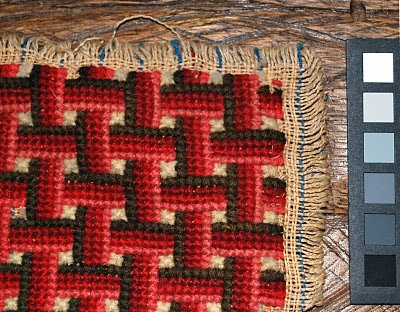

This detail of a Berlin work mat should give you a good idea as to what Berlin work yarns look like up close. I purchased the mid nineteenth-century Berlin work mat for a few dollars at a tag sale a few months ago.

Berlin work designs were published as patterns that were sold in portfolio form or in popular women's magazines. The earlier, European-made patterns tended to be engraved and hand-colored. The later American patterns tended to be lithographed and printed in magazines. I purchased this booklet of small Berlin work patterns at an ephemera sale last spring for $30. It probably dates to the 1850s or so. Small patterns like these were used in conjunction with other motifs on samplers, and they were also added to embellish other projects.


Like needlework that preceded it, Berlin work was made for pleasure, profit, education, and kinship-building; Berlin work was made into objects ranging from samplers to seat covers to book covers to portraits.


This pair of Berlin work slippers was made between 1830 and 1850 in England. Given by Messrs. Harrods, Victoria & Albert Museum, London, T.587 to A-1913.

To my delight, one of the first objects upon which I laid my eyes at the same ephemera show where I purchased the pattern booklet picture above was this book cover. Having completed a research project on needlework book covers (mostly eighteenth-century, although a few nineteenth-century covers made using Berlin wool) while I was studying at Winterthur, I was thrilled to see a Berlin work on perforated cardboard example. This particular cover may have covered a personal keepsake album, but I suspect that is was made to cover a nineteenth-century gift book published under the title Tokens of Remembrance.


Like needlework that came before it, Berlin work was criticized. This criticism is important to understanding the needlework today because it suggests some reasons as to why Berlin work was maligned for so long. These criticisms ranged from issues with aesthetics to objections to the way women used their time. Berlin needleworkers were aware of such objections. Warder herself copied an oft-cited poem bemoaning Berlin work in one of her copybooks in 1842:3

The Husband's Complaint

I hate the name of German wool in all its colors bright,
Of chairs and stools in fancy work, I hate the very sight
The shawls and slippers, that I’ve seen, the ottomans & bags,
Sooner than wear a stitch on me I’d walk the streets in rags.

I’ve heard of wives too musical, too talkative, and quiet,
Of scolding or of gaming wives, and those too fond of riot:
But yet of all the errors known, which to the woman fall,
Forever doing fancy work, I think exceeds them all...

The speaker's wife answers with her own poem, "The Exculpation (In answer to the husband’s Complaint in the matter of His Wife’s Worsted work":

Well to be sure-I never did-why, what a fuss you make
I’ll just explain myself, my dear, a little, for your sake
You seem to think this worsted work is all the ladies do.
A very great mistake of yours-so I’ll enlighten you.

I need’nt count, for luckily I’m filling in just now
So listen, dear, and drive away those furrows from your brow
When you are in your study, dear, as still as any mouse,
You cannot think the lots of things I do about the house...

Authors of needlework handbooks were well aware of such attitudes. They highlighted how practicing Berlin work emulated the upper classes' needlework pursuits. Despite these efforts, many of these aesthetic criticisms evolved into a more cohesive revolt (the aesthetic movement/design reform movement) against a perceived industrialized samenesss and aesthetic messiness. Elite design movements aside, many criticisms were based on long-held misunderstandings about Berlin work, such as the idea that it was made using synthetic dyes (not true), that it did not reflect creativity (similar arguments could be made about eighteenth-century needlework), and that it was a waste of time.

I do not have time to into great depth here about each of these issues (hopefully they will be part of a future publication), but I can tell you that Ann Warder and her use of Berlin work shows that it was not a waste of time or a material production unworthy of close analysis (either historically or today).

Eighteenth-century needlework, which tends to be more highly valued that nineteenth-century Berlin work was often made using some of the same methods used by Berlin workers. Unfortunately, it seems that, thanks to the long-standing dislike for the needlework, few have given it serious scholarly attention. Berlin work does not command anything near what eighteenth-century needlework commands in the market place. On a recent trip to an antiques show, while I analyzed a late Berlin work sampler marked 1875, the merchant noted, "clearly she didn't have a lot of skill." And I didn't have $180 to spend on this unskilled piece of needlework, although an eighteenth century example of needlework the same size would have commanded several hundred dollars at the same venue.

Warder's story shows that, like several historians, curators, and other scholars of women's history and needlework have noted, in the eighteenth through the nineteenth century, needlework served as a way to develop and maintain familial and friendly relations.4 In addition, when it was taught in a school setting, needlework and other "ornamental" arts were seen as complements to the standard "arts and sciences" education.5 Several Berlin work collections associated with the women's academies and seminaries are extant. Whether Warder attended a school is unclear, but the patterns themselves and Warder's letters and account book show that Ann Warder, like her predecessors, lent her patterns to friends an family and that she bestowed hand-wrought needlework gifts throughout her lifetime. Warder was ill for most of her life, ultimately dying of an "ulceration of the stomach" in 1866.6 For Warder, making and exchanging needlework provided her life with cohesion and meaning. The album pictured below is a good example of an English counterpart.


Sarah Bland, a "gentlewoman," made this album in 1866 in England. According to the V&A, "the gift of designs demonstrates connections between relatives of merchant and banking families and is of historical significance in bonding between such families." The album contains Berlin work pattern published by well-known German pattern producers such as A. Todt. Given by Mrs D. McGregor, Victoria & Albert Museum, London, E.372:162-1967.

How does Berlin work--and Warder's story in particular--inform the way we think about needlework, craft, kitsch, fashion, and women's history? Considering the Elle fashion spread and the history of Berlin work's discourse of criticism, the seminar attendees had some fantastic ideas about what has changed (and what hasn't changed) regarding needlework and craft. Despite the fact that many still consider Berlin work in the same negative light as "kitsch," it continues to be fashionable. The Elle spread suggests that its audience deems "craft" fashionable to wear and also, if you have the skill and the time, fashionable to make. Second, another seminarian pointed out continuities in needlework as a group or communal activity. Similar to the way that eighteenth- and nineteenth-century needlework brought women together, so, too, does needlework today. I bet that you or someone you know participates or has participated in a knitting or other needlework group of some kind. If not, needlework's pervasiveness is inescapable one you start looking for it. My boyfriend noted that most of the tag sales we've patronized over the past few months have included hordes of needlework supplies. Here is another example of mid nineteenth-century Berlin work I picked-up at a tag sale for a few dollars.


Berlin work and Berlin work patterns can be found at museums throughout the United States, Berlin work is sold at auction and in retail settings, and Berlin work is collected. This pervasive remnant of the past continues to be important today, whether it is in the world of fashion, the world of "crafts," or the museum world and antiques market. Its pervasiveness alone suggests its historic importance and its continued importance to those have executed it. Berlin work is a poster child for the importance of studying material culture for the sake of understanding it rather that the sake of its beauty. There is no need to be a snob about this, folks--Berlin work is history too. It also looks great on tabletops and walls when used for decorative purposes.

After the discussion with the University of Delaware "Fashion and Fiber" seminar, I am looking forward to exploring Berlin work's relation to "craft" and "kitsch" in more depth. My next presentation will be at the University of Alberta Material Culture Institute's "Material Culture, Craft & Community: Negotiating Objects Across Time & Place" conference in May. Click here to view the program.

In the meantime, please let me know if you have more questions about Berlin work, as I have only scratched the surface here. Also, if you have any images of Berlin work you would like to share, please send them my way! nbelolan at gmail dot com

UPDATE
4 January 2011

Here is an example of a lithographed pattern published in a popular nineteenth-century women's magazine. Patterns such as these were typically included at the beginning of the issue. Some (but not all) were accompanied by a usage note at the rear of the issue. As the 1850s and 60s progressed, more and more patterns (such as this one) featured broader color palettes. Editors boasted about these patterns, noting that readers would spend more on a pattern from a fancy store than on an entire issue of the magazine.7 Needleworkers could have used this pattern in a number of capacities. Needleworkers may have stitched the design onto canvas and framed it. Alternatively, they may have worked the pattern and used it as upholstery or as a piece of a quilt.

I purchased this pattern at an antique mall in northern Michigan last week for $5. I have seen earlier hand-colored examples of about the same dimensions in somewhat better condition for about $25 to $30. I think $5 was a good price for this pattern, although I am concerned about the Scotch tape that is holding the pattern together where it was folded.


Further Reading

Click here to reference my thesis bibliography.

Notes

1. “She’s Crafty: The Season’s Homespun Needlepoints and Crochets
Offer Equal Parts Kitsch and Comfort,” Elle Fashion Trends, Elle, November
2008, 154.

2. The Warder Berlin Work collection is at the Winterthur Museum, in Winterthur, DE, 2004.0071.001-.148.

3. “The Husband’s Complaint,” Copied by Ann Warder, 5 August 1842, and “The Exculpation (In answer to the husband’s Complaint in the matter of His Wife’s Worsted work,” Copied by Ann Warder, 5 August 1842, in Poetry Notebook, ca. 1841-1844, 12-14, Box 105, J-CFP.

4. Catherine E. Kelly, In the New England Fashion: Reshaping Women’s Lives in the Nineteenth Century (Ithaca, NY: Cornell University Press, 1999), 55; Amanda Vickery, Behind Closed Doors: At Home in Georgian England (New Haven: Yale University Press, 2009), 245-246.

5. Mary Kelley, Learning to Stand and Speak: Women, Education, and Public Life in America's Republic (Chapel Hill: University of North Carolina Press, 2006), 76-81.

6. Ann Warder, Death Certificate, Vol. 1, 1866, no. 105, Philadelphia City Archives, Philadelphia, PA.

7. Warder Collection, 2004.71.122, “Pattern for Chair Seat,” Peterson’s Magazine, January 1863, 85 and Warder Collection, 2004.71.108, and “Berlin Work Pattern./For Sofa Pillow, Footstool, Bag, Ottoman, or Fender-stool,” Peterson’s Magazine, December 1860, 484.

Wednesday, September 1, 2010

Material Culture "Fiber and Fashion" Seminar at the University of Delaware

Please take note of a material culture seminar at the University of Delaware this fall:

Fiber and Fashion: Reimagining the Sources and Use of Textiles

I will be speaking 29 September: "Berlin Needlework: Victorian Craft or Kitsch?"

In conjunction with with my own talk/workshop for the series, I will devote one to two blog entries to Berlin work and/or the talk/workshop experience.

I hope to see you there!

Sunday, August 29, 2010

"I really shouldn't be accumulating too many things."


This entry's titular quotation was muttered by an older woman walking the New Castle Antiques Show grounds. Indeed, her sentiment was the theme of the day.

On my way to the Show, I discovered that one of Delaware Street's residents was arranging items for sale on the sidewalk and in the backyard. I learned from a customer sitting in the backyard that the house's owner is some German baron and that he instructed his caretaker to start emptying the house in an effort to liquidate the home's contents. Nothing was marked with a price, and most of the furniture was falling apart, covered in grime, or re-finished within an inch of its life. Not very tempting, but there is something enchanting about a black horsehair-covered Victorian sofa bursting with its stuffing until you remember that you do no know how to reupholster furniture. What more would one expect from a house whose windows' paint is chipping and falling onto the sidewalk? I really just wanted to take a walk through the house tag sale style, but that didn't seem to be an option.

The customer I met struck up a conversation with me. After learning that I graduated from Winterthur, etc., and that I'm into history, he asked me whether I could "authenticate" the set of rococo (Chippendale) side chairs in the front of the house. He said the caretaker wanted $400, and he explained that if I thought they were worth more, he would put up the money, and we could split the resale profit. Who knew all I had to do was walk down the street to find a business partner? The fact is that I don't know the value of an average, refinished mid c18 side chair that lacks provenance (without doing research), and, as I noted yesterday, I do not buy to sell (which is why the blog is titled "Picking for pleasure..."). A nice thought, but not a hobby for a Ph.D. student. I looked around a bit more, never meeting the house's caretaker (who obviously needed some coaching in selling), and continued on to my destination.

There was a line outside the Show. A few people budged in line in front of me. A local dressed in colonial garb was serenading us with his fife and soliciting customers for his wife's local business. Despite the fact that I applied bug repellent prior to leaving my apartment, I had a bug bite within five minutes. After standing in the blazing sun for about ten minutes, I finally reached the entrance, paid the entry fee, and started searching for my next conquest.

The booths and tents were crowded. It was hot. I had no water with me. I powered-on, though, and saw a few things I could not afford but really admired, yet another box like the one I mentioned yesterday (this example larger, in better condition, and more expensive), and a few items within my budget that tempted my pocketbook.

One dealer was peddling a "courting" sleigh. The exterior was red, if I recall correctly, and it was upholstered with faded woven fabric decorated with an embossed stylized floral motif. The sleigh dates to the late nineteenth century and was priced at over $1,000. Some of the upholstery springs were visible, but, with some conservation work, I think the sleigh would make an interesting piece of seating furniture.

Another dealer had a framed mid nineteenth-century collage made with a lithographed woman's or child's face. The neck and upper-chest area was "dressed" with a red silk fabric and some sort of lace. One of my Winterthur classmates recently completed a thesis on "dressed" miniatures (focusing on miniaturist Mary Way), so I was aware of this craft's history. Priced at $135, it was out of my price range, but its visual appeal played to my "need" for wall decorations. As I walked through the show, I kept it in mind but ultimately decided that it was striking but out of my price range.

Finally, the dealer from whom I purchased my single find of the day was also selling a small black tin box that contained a set of mid-late nineteenth-century stencils. Each stencil was about 1.5"-2" high. The set was missing the letter "N" and the number "8" but was otherwise complete. It also came with what appeared to be a paint or ink well. The price was right--only $36, but it was black and had no provenance...and it lacks my first initial.

Ultimately, I followed the rules I set yesterday, preventing myself from "accumulating too many things." Not only did I buy a house for $15 (a fair price for a small piece of unsigned piece of mid c19 needlework), but I bought something colorful that I can hang on my wall. It's a small Berlin needlework fragment depicting a house on blue perforated cardboard. I will discuss it within the next month or so after I give a talk on my Berlin work thesis for a textile seminar at the University of Delaware. In the mean time, it will serve as my metaphorical house, filled with imaginary courting sleighs and stencil boxes.


I am happy with my acquisition, but I only witnessed a handful of other transactions. I overheard several people mention that there were fewer dealers here this year than there were last year. Many dealers were lamenting that no one was buying. Based on my own observations, the market hit a low in the winter of 2008-2009, rebounded a bit in between then and now (thanks to "the stimulus," perhaps), and has started to decline again. "I really shouldn't be accumulating too many things."

More for me!

At any rate, by the time I finished trolling the Show, I was dehydrated and ravenous. I purchased a pulled pork sandwich and a Diet Coke from a vendor on site and started walking back to my apartment, bypassing the house liquidation and being punished for resisting "accumulating too many things" by slipping and falling onto the sidewalk and onto my right side in front of a lot of people who paid no attention.

The fall aside, I am happy to report that the adventure was less traumatic than the nightmare I had last night in which nothing was for sale at the Show except for school and airport furniture (in bad condition!) from the third quarter of the twentieth century.